Strength Training Over 60 in East Finchley, London (N2)
Strength training over 60 at Ultimate Strength is one-to-one, supervised, machine-based work in a private studio in East Finchley, North London (N2). One 45-minute session a week is, for most clients in their 60s and 70s, enough to rebuild and hold real strength. We are not a clinic and we are not age-restricted - but many of the people who train here are training in later life, and the floor is set up with that in mind.
What strength training over 60 looks like here
One coach, one client, by appointment, in a private studio. Forty-five minutes, once a week. No class, no shared floor, no rotating instructor. The equipment is MedX and Nautilus - resistance machines built for precise loading rather than free-weight athleticism. You sit, the coach sets the weight, and each repetition is performed slowly enough that momentum cannot do the work for you.
The protocol is High Intensity Training (HIT) - a slow, controlled, one-to-one strength protocol, distinct from HIIT (High Intensity Interval Training). It is brief by design. Most clients train for forty-five minutes a week and recover the rest of the week. People in their 60s and 70s usually tolerate the format better than they expect, because it removes the things that make conventional gyms hard at this stage of life: speed, balance under load, technique you do not have time to learn, and the social pressure of a busy floor.
The obvious worries - joints, balance, fatigue, blood pressure - are worth naming. We address them by loading one muscle group at a time, on equipment that supports the rest of the body; by removing momentum from every repetition; by progressing in small written increments week to week; and by stopping when the session is done rather than chasing a feeling. If your doctor has set restrictions, we work within them.
Why machine-based loading suits training in later life
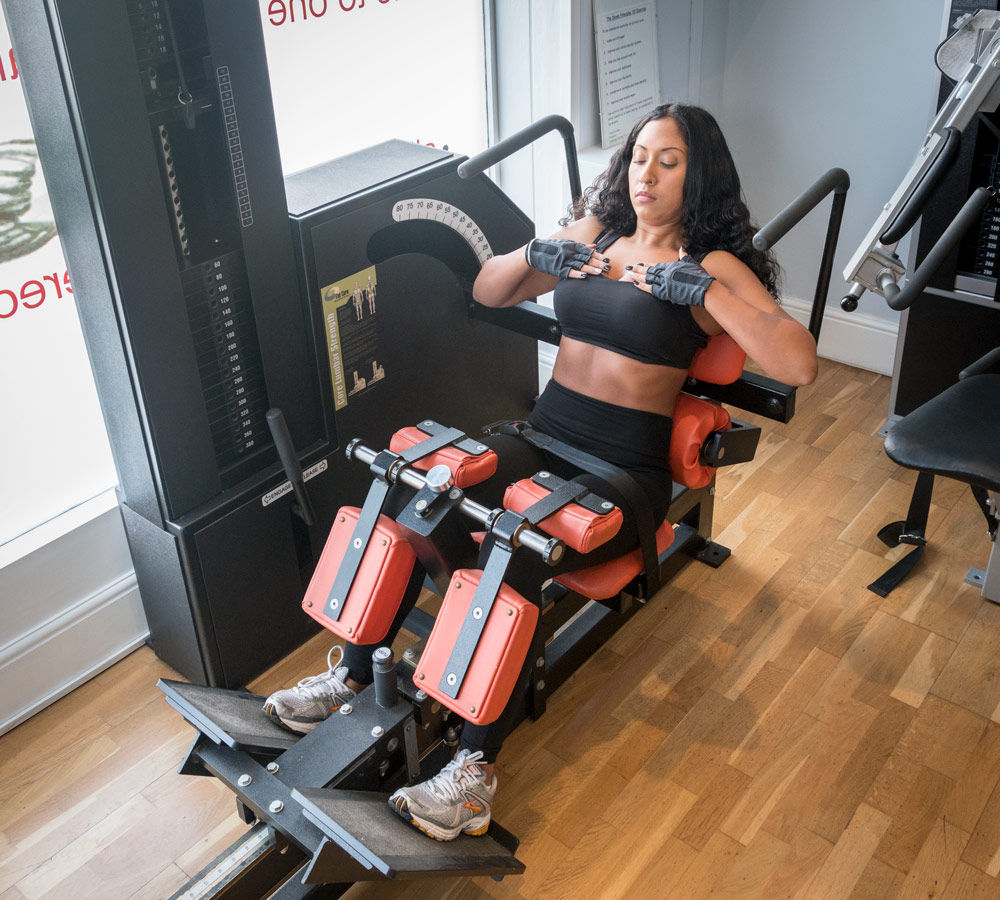
The MedX and Nautilus machines on our floor were designed to isolate one muscle group at a time and support the rest of the body while they do it. For an older client, that has practical consequences.
You are not balancing under load. You are not learning a complex barbell technique. You are not chasing a bar across the floor, or queuing for a rack, or working around someone else’s set. The seat, the pad and the pelvic restraint hold you in position; the cam handles the resistance curve; the coach watches the movement. Your job is to lift and lower slowly, in a range that suits your joints, and stop when the set is done. See The gym for the full equipment list.
Why this matters after 60
Muscle mass declines slowly from the mid-thirties and then more steeply from around sixty. The medical term is sarcopenia - the age-related loss of skeletal muscle. Bone density tracks behind it. Balance, posture and metabolic health all sit on top of those two foundations. Walking, swimming and cycling are good for many things, but they do not stimulate muscle or bone at the intensity needed to slow the loss.
Resistance training does. Loaded, slow, full-range work asks the muscles to produce force and asks the bones to carry it. That is what triggers the remodelling response in both tissues. For lumbar and hip bone density specifically, supervised machine work on the right equipment is one of the few practices with a real published track record - one reason we treat Strength Training for Osteoporosis as a sibling page to this one.
The everyday version of all this is more immediate. Strength is what carries the shopping up the stairs, gets you up off the floor unaided, lets you garden for an afternoon without paying for it the next day, and lets you pick up a grandchild without thinking about your back. Clients in their 60s and 70s tend to notice the everyday changes first - posture, stairs, getting in and out of a car, sleep - and the measured strength gains on paper second.
“Being the wrong side of 60 and having read that muscle strength wastes away the fastest, I decided to go to Ultimate Strength. Yoram has tailored each exercise so that if I don't go to him twice a week, I actually miss the challenge of seeing if I can improve the reps he sets.”
Frank Harris · client, training twice a week in his 60s
Who this is for
Most of the people who come to us specifically for strength training in their 60s, 70s or 80s fall into one or more of these groups.
- People who have never done structured strength training, or have not done any for decades, and want to start somewhere that will not assume gym literacy.
- People coming back after an injury, a procedure or a period out of action - a hip or knee replacement, a back episode, a cardiac event, an illness that took the year - who have been cleared to load and want supervised progression. The Lower Back Rehabilitation page covers the back-specific case in detail.
- People worried about sarcopenia, falls or bone density who have read the research and want a practical answer rather than another walking habit.
- People who tried a conventional gym and bounced off - the noise, the floor, the pace, the lack of supervision - and want a quiet room and one coach.
The youngest client on our books is 12 and the oldest is 86. Most clients are older. The Clients page has the full breadth. We are not pitched at any one age group, and a 68-year-old will not be the oldest person on our books or anywhere close.
Who this is not for, at least not yet
We will say so on the phone or at a first visit if any of these apply.
- Acute injury or pain. If something is currently flaring, see your GP or physiotherapist first.
- Uncleared post-surgery. If you have had a recent procedure and your surgeon has not yet cleared you for resistance work, wait for that sign-off. Once cleared, Post-Surgical Strength Training is the dedicated route in.
- A specific condition where your doctor has advised against resistance training. Bring whatever guidance you have. If anything is unclear we will ask for written sign-off from your doctor before starting.
None of these are permanent disqualifications. They are often a question of timing.
“In spite of an ongoing back problem for the past thirty years, strength training has benefitted me enormously. Best of all, it is a form of training that has no age barrier, and can be continued in later life, keeping us toned and strong.”
Janet Wise · long-standing client
How a first session works
It takes about forty minutes and looks the same whether you are 38 or 78.
- We walk the floor and look at each machine. You will see the MedX lumbar extension, the leg press, the chest and back machines and the rest of the equipment described on The gym .
- You talk through your history - what you have done, what you have not done for a while, any injuries, any procedures, any conditions your doctor has flagged, and anything you have been told to avoid.
- You try a single calibration set on one or two machines. The starting weight is set well below your capacity. The point is to feel the cadence and the movement, not to test the muscle.
- We agree whether a programme makes sense. There is no commitment to continue. If we think a different setting suits you better right now, we will say so.
If you do continue, sessions are by appointment, one to one, with the same coach every visit. The coach is Yoram Sher , who has been running Personal Strength Training here since 2005. We keep a written log of every weight, set and note, and you are welcome to a copy at any time, including to share with your GP, physiotherapist or consultant. The longer view of how we work sits on Our approach .