Strength Training for Osteoporosis in East Finchley, London (N2)
Strength training for osteoporosis at Ultimate Strength is one-to-one supervised loading on MedX and Nautilus equipment, in a private studio in East Finchley, North London (N2). Sessions are by appointment, the cadence is slow, and the goal is to load the bones that matter most - the lumbar spine and the hips - in small, recorded increments over months and years.
What we mean by strength training for osteoporosis
We mean Personal Strength Training, performed slowly and supervised, with the bones of the lumbar spine and the hips loaded through the muscles that attach to them. Specifically: the MedX Core Lumbar Strength machine, the Nautilus Leg Press, and a small set of paired hip, trunk and upper-body machines, used once a week, for forty-five minutes, by appointment, with a Kieser-trained coach standing next to you.
We are not a clinic. We do not run DEXA scans, we do not interpret T-scores, and we do not prescribe medication. What we do is build the muscles that pull on the bones of the lumbar spine and the hips - the two sites where age-related bone loss tends to bite first - carefully, in small increments, in a setting designed for older clients and people training around a diagnosis. Many of our clients arrived after a GP, a consultant or a physiotherapist suggested that loaded strength work might help slow further loss.
The protocol behind the page is High Intensity Training (HIT) - a slow, controlled, one-to-one strength protocol, distinct from HIIT (High Intensity Interval Training). It is the same method we use across our approach and on the related Lower Back Rehabilitation page, applied here with bone-density in mind.
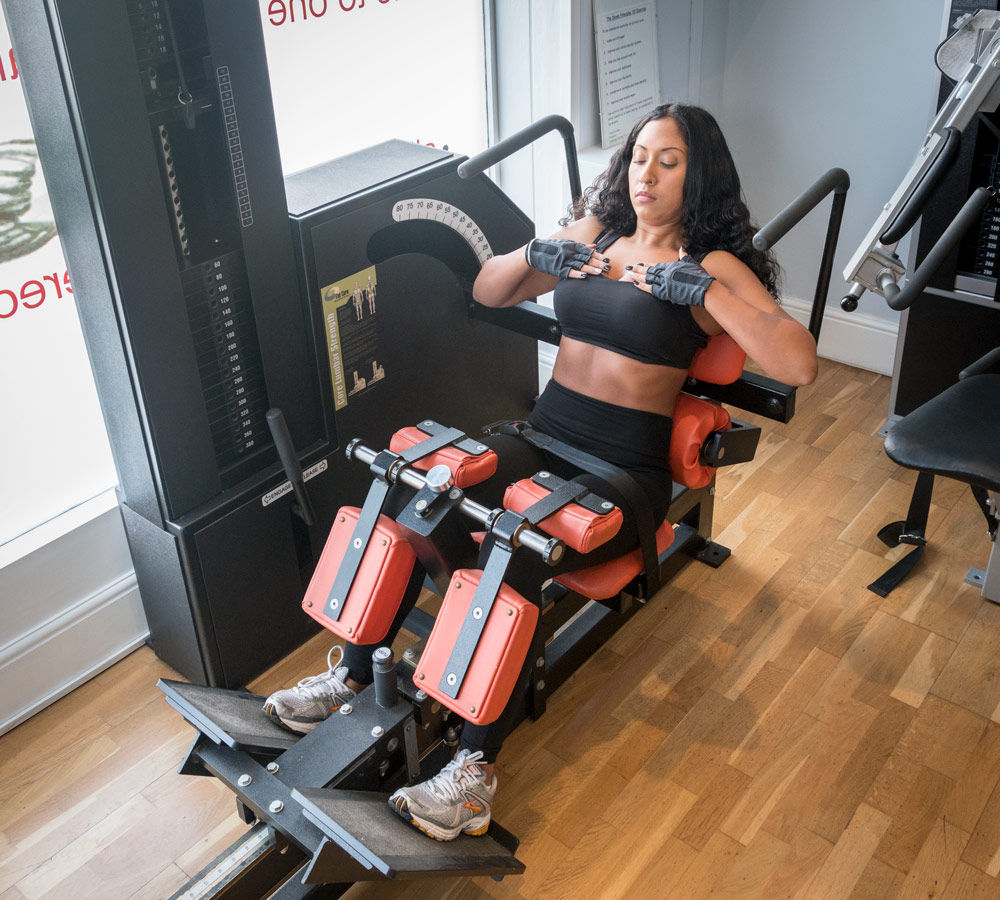
Loading the spine and the hip pattern
Bone responds to load. The two sites that most commonly thin first with age - the lumbar vertebrae and the femoral neck around the hip - are also the two sites this floor is best set up to load.
The MedX Core Lumbar Strength machine has a patented pelvic restraint that locks the hips, so the lumbar muscles cannot be substituted for by the gluteus or hamstrings. The result is loaded extension that the spine cannot easily avoid - exactly the stimulus that vertebral bone needs to maintain density over years. Alongside it, the Nautilus Leg Press loads the hip and femur through the major lower-body movers without putting a bar across the back of the neck. The full equipment line-up is described on the gym page.
Why slow, supervised loading suits osteoporosis
Three reasons, in plain terms.
- No momentum. A ten-second lift and ten-second lower removes the snap and yank that can fracture a fragile vertebra under conventional weight training. The bone is loaded smoothly in both directions, never jerked, and the muscle does the work the bone needs it to do.
- Controlled progression. Increments are small - typically one to two and a half kilograms a week, never more than the previous session has earned. For someone with osteoporosis or osteopenia, the protective ceiling matters as much as the progression itself.
- A written record. Every weight, set and note is recorded on paper. That record makes it possible to share progress with your GP or consultant between scans, and it makes it impossible to drift into a load you have not already shown you can handle.
A 45-minute session a week is, for the average client, enough. Recovery happens between visits, and the work is brief enough that people training around an osteoporosis diagnosis can usually get through a session without aggravating anything that bothered them on the way in.
“Bone is a slow conversation. You show up, you load it carefully, you write down what you did, and you come back next week. The change is in the years.”
Yoram Sher · Director and head coach
Who this is for
Most of the people who come to Ultimate Strength for strength training around osteoporosis fall into one or more of these groups.
- Osteopenia picked up on a routine DEXA scan, where a doctor has suggested loaded strength work as part of slowing the slide toward osteoporosis.
- Established osteoporosis in a stable phase, where you have been cleared to load and want supervised progression rather than a group class.
- Post-menopausal bone loss where strength training is one of the levers being used alongside whatever your GP or consultant has advised.
- A family history of fragility fracture that has prompted a decision to take loaded training seriously while it is still preventative work.
- A long gap from any resistance training in your sixties, seventies or eighties, with a sense that the bones need the load even if the muscles are not what they were.
Who this is not for, at least not yet
We are honest about this on the phone and at a first visit.
- If you have severe osteoporosis - a low T-score, multiple risk factors, or a clinician who has advised caution with loading - we will ask for written sign-off from your doctor or consultant before starting. That is not a formality; it is how we keep you safe.
- If you have had a recent fragility fracture, particularly a vertebral compression fracture, wait until your treating clinician has cleared you for resistance training. The MedX lumbar extension is built for loaded extension, and that is precisely the movement a healing vertebra may not yet be ready for.
- If you are currently on a course of treatment that includes restrictions on resistance training, follow the restrictions first. We are happy to liaise with your GP, consultant or physiotherapist about when, and how, to start.
An introduction session is the easiest way to find out which side of this line you sit on.
“In spite of an ongoing back problem for the past thirty years, strength training has benefitted me enormously. Best of all, it is a form of training that has no age barrier, and can be continued in later life, keeping us toned and strong.”
Janet Wise · long-standing client
How a first session works
It takes about forty minutes.
- We walk the floor and look at each machine.
- You talk through your bone-density history, any DEXA reports or letters from a consultant you want to share, and any restrictions your doctor or physiotherapist has set.
- You try a single calibration set on the MedX Core Lumbar Strength machine and, if time allows, the Nautilus Leg Press. The starting weight is set well below your capacity. The point is to feel the movement and confirm tolerance, not to test the bone.
- We agree whether a programme makes sense. There is no commitment to continue, and we will say so plainly if we think you need a sign-off from your GP or consultant before we start, or if a different setting is a better fit for you right now.
If you do continue, sessions are by appointment, one to one, with Yoram on the floor every visit. We keep a written log of every weight, set and note, and you are welcome to a copy at any time, including to share with your GP, consultant or physiotherapist between DEXA scans.