Post-Surgical Strength Training in East Finchley, London (N2)
Post-Surgical Strength Training at Ultimate Strength is one-to-one supervised strength training for people whose surgical team has cleared them to load again. Written sign-off from your surgeon is the non-negotiable starting point. The protocol behind every session is High Intensity Training (HIT) - a slow, controlled, one-to-one strength protocol, distinct from HIIT (High Intensity Interval Training).
What we mean by post-surgical strength training
We work with people who have come through a procedure or operation - a hip replacement, a knee replacement, a rotator cuff repair, a discectomy, a laminectomy, a spinal fusion, abdominal surgery - and whose surgical team has cleared them to load the body again. Sessions are one to one, by appointment, on MedX, Nautilus and Cybex machines, in a private studio at 140 East End Road. The protocol is High Intensity Training (HIT) - a slow, controlled, one-to-one strength protocol, distinct from HIIT (High Intensity Interval Training).
We are not a clinic, and we are not a substitute for the physiotherapy your surgical team has set. We do not diagnose, prescribe or run your post-operative rehabilitation plan. What we offer is a careful, supervised setting in which to build strength back once the people responsible for your recovery have said you are ready to load. Many of our clients arrive on the recommendation of a physiotherapist or consultant for exactly that reason.
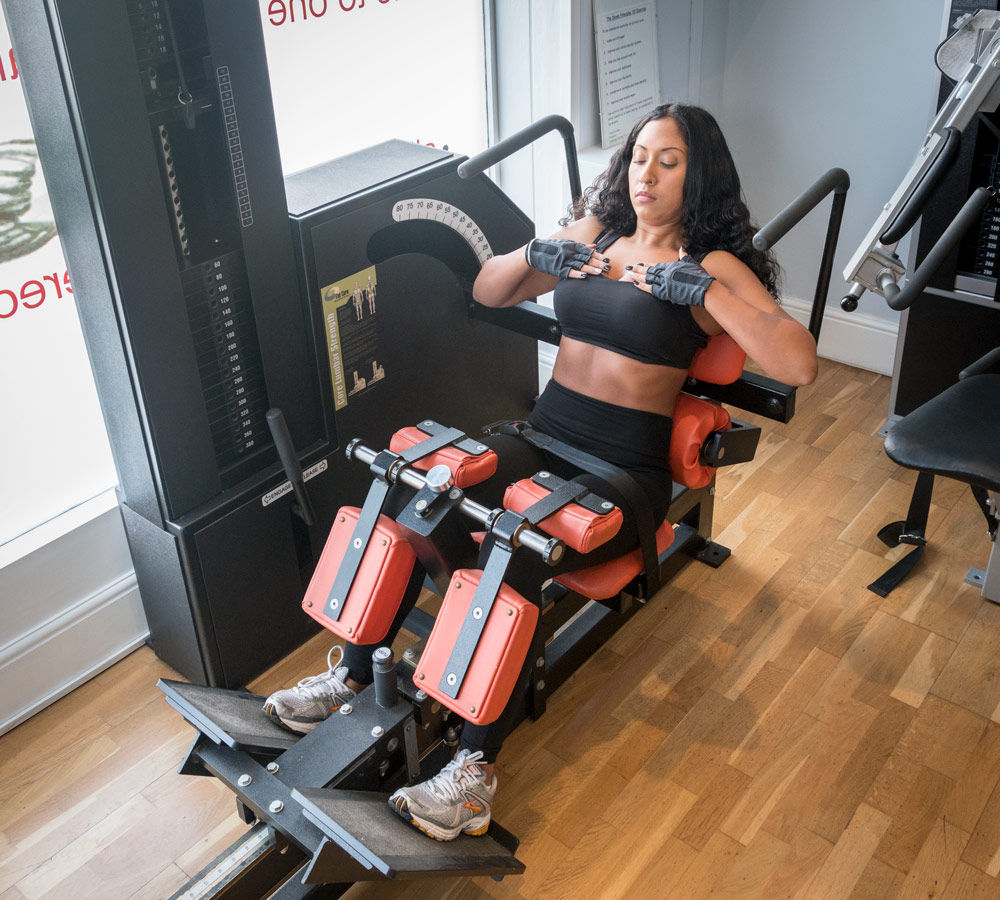
Why machine-based loading suits post-surgical work
The MedX and Nautilus machines on our floor constrain the joint to a fixed path. That matters after surgery for three reasons. The first: the surgical site is not asked to stabilise an unfamiliar movement under load. The second: the weight is incremental, set in small steps, and recorded in writing every session - so progression is measured rather than guessed. The third: there is no requirement to learn a barbell or free-weight pattern while you are still cautious about a recent procedure. You sit, you are restrained where the equipment is designed to restrain, and you move through the prescribed range at the prescribed speed.
The same approach has carried clients through recovery from cardiac procedures, joint replacements and back surgery - see the gym for the full equipment list.
Why supervised loading suits post-surgical progression
Three reasons, in plain terms.
- No momentum. A ten-second lift and ten-second lower removes the snap and yank that injure healing tissue. The surgical site is loaded smoothly in both directions, never jerked.
- One muscle group at a time. The machine restraints let us load the target muscles in isolation, so the rest of the body does not have to brace, twist or compensate around the operated joint.
- Small, documented increments. Increments are typically one to two and a half kilograms a week, written down by hand and calibrated to the previous session. You progress when you have already shown that the current weight is comfortable.
For most clients, one 45-minute session a week is enough. Recovery happens between visits. The session is brief enough that even people in the early cleared-to-load weeks can usually complete it without aggravating the surgical site.
“Having had major shoulder surgery I came to Ultimate Strength at the suggestion of my physiotherapist. In consultation with my therapist, Yoram designed a programme that enabled me to re-establish the strength in my rotator cuff and because of that I was able to get back to playing tennis much faster than I had expected.”
Sydney Faber · client, recovery from rotator cuff surgery
Procedures we commonly work around
Each of the following is something we have programmed around before. In every case, what we do is shaped by the restrictions your surgical team has set.
- Hip replacement. Typical early restrictions include limits on deep flexion, adduction past midline and internal rotation. We pick machines and ranges that respect those limits while loading the surrounding musculature - quadriceps, glutes, hamstrings - in their permitted range.
- Knee replacement. We work with whatever range of flexion the surgical team has cleared, building quadriceps strength on machines that load the knee without asking it to stabilise a free weight. Progression follows the range that has been signed off, not what feels possible on the day.
- Rotator cuff repair. Often a long horizon, with strict early restrictions on overhead loading and external rotation. We stay well within them, working other body areas in the meantime, and reintroduce shoulder work in the order and range your physiotherapist has set.
- Lower-back surgery (discectomy, laminectomy, fusion). Once your surgeon has cleared loading of the spine, we may use the MedX lumbar extension or hold off from it entirely, depending on what has been cleared. See Lower Back Rehabilitation for the longer write-up on how we work with spinal cases.
- Abdominal surgery. The general principle: once you are cleared to load, we can build a session that avoids straining the abdominal wall while still progressing strength elsewhere. As healing progresses, trunk and core work is reintroduced in the order the surgical team is comfortable with.
Other procedures - cardiac, gynaecological, hernia repair, prostate, oncological surgery, joint arthroscopies - we have worked around before. If you have been cleared to load, we can usually build a session. Bring the discharge guidance and we will read it carefully.
Who this is for
Most of the people who come to Ultimate Strength after a procedure fall into one or more of these groups.
- Cleared by the surgical team to load and looking for a quiet, supervised setting in which to do it.
- Mid-way through a longer recovery where the physiotherapy is in place and strength work is the natural next layer.
- Returning to sport or active work after a joint replacement, rotator cuff repair or spinal procedure.
- Older clients who want to recover the strength lost during the weeks of restricted movement around an operation - see Strength Training Over 60 for more on this group.
- Clients managing other conditions alongside the surgery - osteoporosis being a common one. See Strength Training for Osteoporosis .
Who this is not for, at least not yet
We are honest about this on the phone and at a first visit.
- If you have not been cleared to load by your surgical team, wait. Strength training is not the right next step before that conversation has happened.
- If your consultant or surgeon has set specific restrictions that you have not yet shared with us, we cannot start until we have seen them in writing.
- If you are in acute post-operative pain or are still in the early healing window where the surgical team has not yet given a green light, the right setting is your physiotherapist, not our floor.
- If anything in the discharge guidance is unclear, we will ask for a short email from your consultant or physiotherapist before we begin.
“We will adapt the programme around whatever restrictions your surgical team has set. What we will not do is run your rehabilitation. That belongs to the people who operated on you and the physiotherapist they have set you up with.”
Yoram Sher · Director and head coach
How a first session works
It takes about forty minutes.
- We walk the floor and look at each machine.
- You talk through your surgical history, share any discharge letter, operative notes or physiotherapy guidance, and tell us what restrictions the surgical team has set. If we need anything in writing that you do not have to hand, we will ask before we start.
- You try a single calibration set on a machine that respects every restriction. The starting weight is set well below your capacity. The point is to feel the movement, not to test the muscle.
- We agree whether a programme makes sense. There is no commitment to continue. We will not progress past the calibration weight until you have shown that it is comfortable, and we will say so plainly if we think a different setting is a better fit for you right now.
If you do continue, sessions are by appointment, one to one, with Yoram every visit. We keep a written log of every weight, set and note, and you are welcome to a copy at any time, including to share with your physiotherapist or consultant. More on the practice behind that in our approach .