Pay as you go
Single session
£85 per session
No commitment
- One supervised 60-minute session
- Full written record of the workout
- Cancel or reschedule with 24 hours' notice
- No joining fee, no minimum commitment
The protocol behind Ultimate Strength is not new. It draws on strength-training research developed in Florida in the 1980s and refined for the strength-rehabilitation gyms of Switzerland and Germany. What follows is what you can expect, and why we work this way. High Intensity Training (HIT) - a slow, controlled, one-to-one strength protocol, distinct from HIIT (High Intensity Interval Training) - is the method that sits behind every session.
Most gyms ask you to train often, move quickly, and tolerate discomfort. We do the opposite. Clients come once a week for forty-five minutes. Each repetition is performed slowly enough to remove momentum entirely - ten seconds to lift, ten to lower - so the muscle, not the joint, carries the load.
Under those conditions, even a brief session produces a complete training stimulus. Recovery happens between visits, and progress is recorded in writing every week. We do not chase exhaustion. We chase precision.
Each session moves through six to eight exercises in sequence, covering the major muscle groups, the trunk and the lower spine. Spine, neck and trunk work is done on the four MedX Core Spinal Fitness System machines - Core Lumbar Strength, Core Torso Rotation, Core 4-Way Neck and Core Super Stretch - which together isolate the stabilising muscles in a way no free-weight exercise can match. The weight on each machine is calibrated to your strength at the previous visit and adjusted in small increments - typically 2.5 pounds - when you complete a set within range.
“The slower you move, the more honest the work becomes. Speed is where injuries hide.”
Yoram Sher · Director and head coach
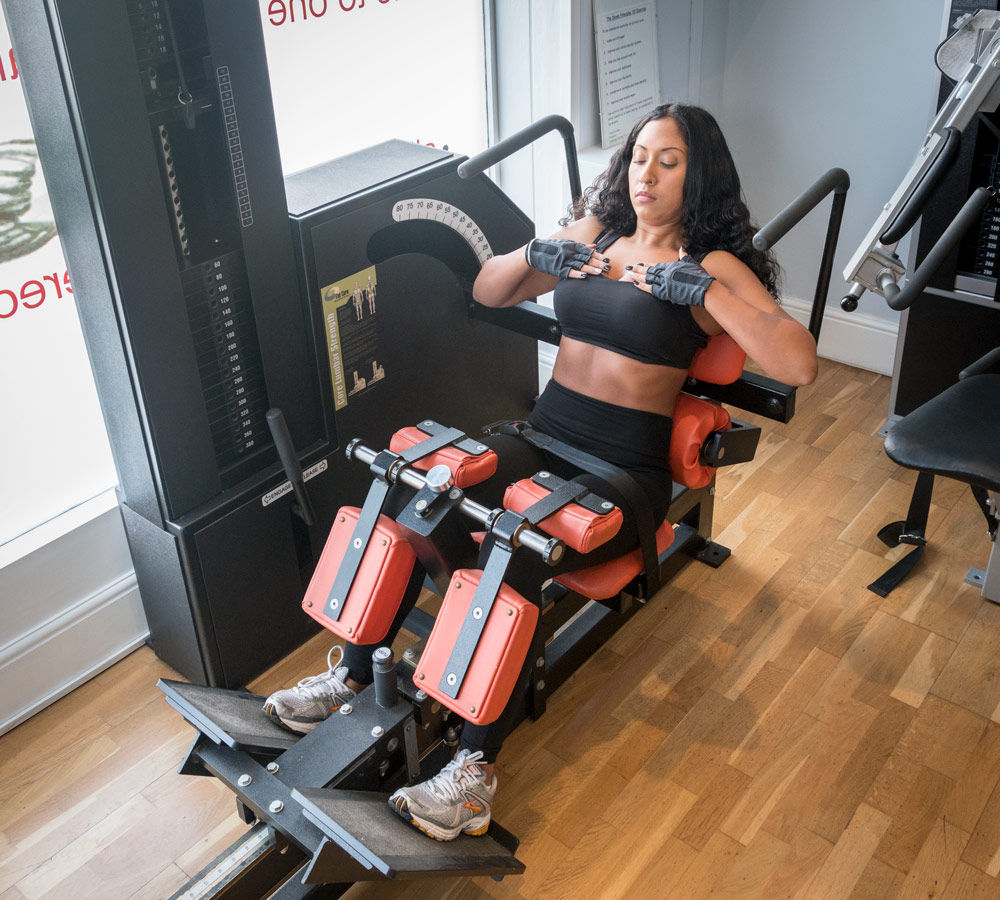
The MedX lumbar extension machine isolates the muscles of the lower back without loading the discs of the spine. Originally developed for rehabilitation settings, it remains the most studied piece of strength-rehabilitation equipment in the world.
Our floor also includes Nautilus and Cybex variable-resistance machines for the chest, shoulders, hips and knees - each chosen for biomechanical accuracy rather than aesthetic.
Our clients are adults of all ages. Many arrive with a specific reason: long-standing lower-back pain, osteoporosis, recovery from surgery, arthritis, or a recommendation from their doctor to build bone density and stability. Others come because they have run out of patience with conventional gyms.
What unites them is a willingness to commit to one short, careful session a week - and to measure their progress in years rather than weeks.
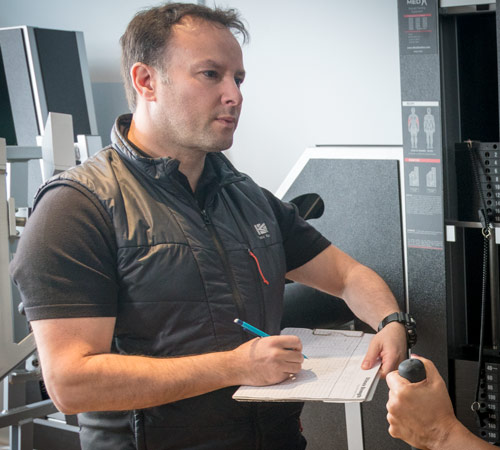
We keep a written log for every client - weight selected, repetitions completed, time under load, and any notes your doctor or physiotherapist has shared. The same record is used to calibrate the following session and to track strength gains year on year.
You receive a copy of your record on request, and we are happy to share it with your GP, physiotherapist or consultant.
Per-session payment allows you to sample the system without commitment. Pre-paid blocks of ten or twenty sessions carry a small discount and lock in your rate for the duration - useful if you are training intensively toward a procedure, an event, or a specific milestone.
£85 per session
No commitment
£810 = £81 / session
5% discount · paid in advance
£1,580 = £79 / session
7% discount · paid in advance
The majority of our clients arrive with a history of lower-back issues - that is precisely what the MedX equipment was designed for. We work alongside physiotherapists and consultants regularly, and will adjust the programme around any restriction your doctor or physiotherapist has given you.
If you are unsure whether strength training is right for you, we will ask for written sign-off from your doctor or physiotherapist before starting.
Muscle is made of three families of fibre - slow-twitch, intermediate fast-twitch and pure fast-twitch - which fatigue in sequence rather than in parallel. A single set, taken slowly to controlled failure, recruits all three. If you rest for a few minutes and start a second set, the same fibres are recruited again in the same order, with no fresh capacity to find.
One properly executed set produces the training stimulus. A second set, at this cadence, mostly produces unnecessary recovery cost.